



















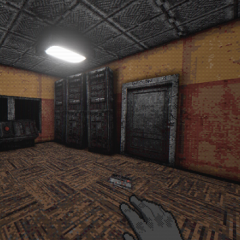







Side Hustle introduces the player to a modest carpet shop that appears entirely ordinary at first glance. You begin your shift with the expectation of a typical workday: open the door, prepare the store, and keep things organized. The setting is compact, quiet, and predictable. Yet as the minutes pass, the atmosphere subtly shifts. The familiar store layout becomes a backdrop for small disturbances that challenge the player’s understanding of what is normal. The experience relies on the tension between routine and uncertainty.
Opening Tasks and Early Routine
During the initial phase of Side Hustle, the player focuses on simple activities. You walk through the store, straighten displays, and check for anything that requires attention. These tasks feel practical and grounded, giving the impression of a stable work environment. However, soon you notice details that do not match your memory — a rug seems moved, a shadow appears where nothing should cast one, or a sound echoes from somewhere out of sight. None of these moments interrupt gameplay, but they introduce questions about what is happening inside the store.
Escalation of Irregularities
As the day progresses, Side Hustle shifts from subtle discomfort to clear unpredictability. Actions that once produced consistent results now lead to unexpected outcomes. The store behaves like a closed system reacting to forces the player cannot identify. The disruptions do not follow a clear pattern, and each new moment challenges the assumption that this is merely a quiet retail job.
A typical playthrough may involve:
· displays rearranging themselves between visits,
· customers acting oddly or disappearing too quickly,
· unusual sounds behind shelves or storage doors,
· lighting shifts that alter the appearance of the store,
· attempts to exit that feel delayed or obstructed.
These elements gradually build a sense of unease without relying on direct confrontation.
Themes and Underlying Meaning
Side Hustle uses its limited environment to explore how quickly comfort dissolves when routines stop behaving as expected. The carpet shop functions as a symbolic space where the illusion of control fades. The game encourages the player to pay attention to minor details and notice how familiar settings can shift into uncertainty. Instead of dramatic threats, the tension comes from the quiet breakdown of everyday order.
The conclusion of Side Hustle offers no definitive explanation for the store’s behavior. The player leaves with unresolved questions, unsure whether the events were caused by external forces or internal perception. The ambiguity is purposeful, reinforcing the theme that even the simplest environments can feel unstable when expectations fail. Side Hustle transforms ordinary work into a narrative of doubt, observation, and subtle psychological tension.
